82%
Maintenance coordination
119 of 145 companies had public operating evidence that supported maintenance intake, vendor coordination, repair approval, inspection, or closeout as a first workflow to examine.
Original research · July 2026
A structured review of public company information found the same operating work again and again: maintenance coordination, exception routing, owner communication, leasing, and financial follow up. This report shows where an AI employee may fit and where people must stay in control.
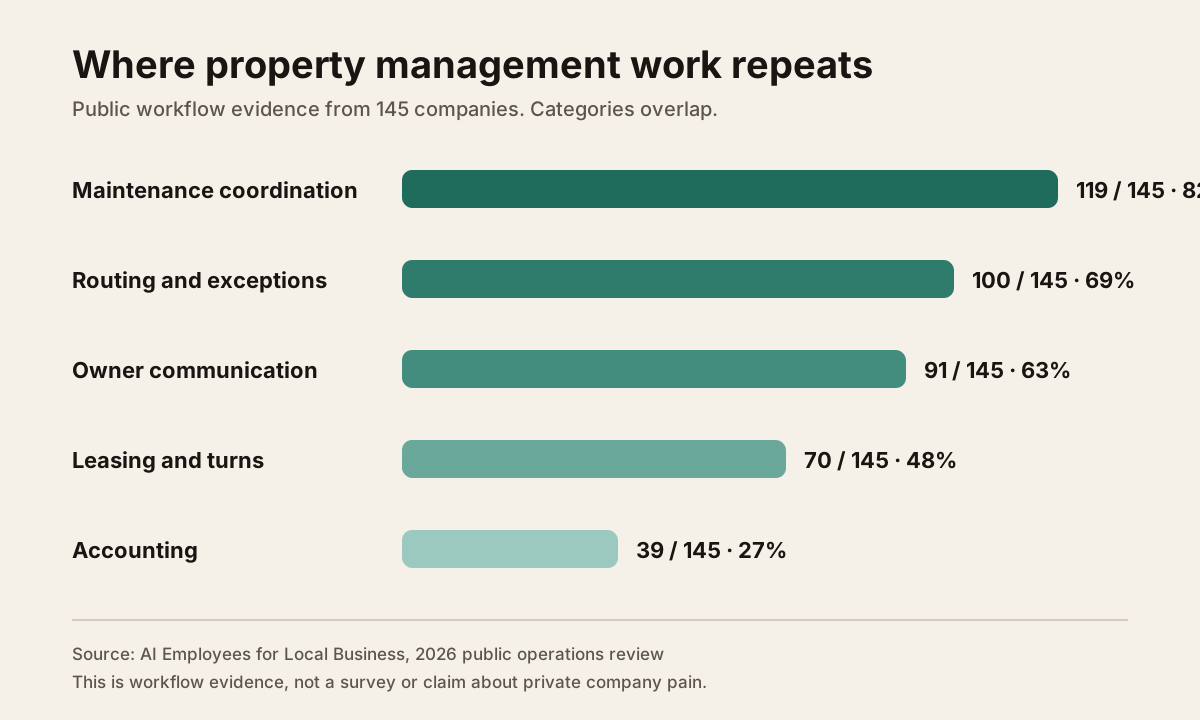
Maintenance is the clearest first workflow to test. Public operations supported a plausible maintenance coordination use case at 119 of 145 companies, or 82%. Routing and exception management appeared at 100 companies, or 69%. These patterns overlap because one maintenance request often crosses residents, staff, vendors, owners, accounting, and the property management system.
Five recurring workflow patterns
Each company could appear in more than one category. A leasing turn may involve maintenance, accounting, owner approval, and an exception queue. The percentages describe how often public company information supported a plausible first constraint to test. They do not say that the company reported a problem.
82%
119 of 145 companies had public operating evidence that supported maintenance intake, vendor coordination, repair approval, inspection, or closeout as a first workflow to examine.
69%
100 of 145 companies showed work moving among people, systems, departments, or queues where assignment, follow up, status, or escalation may be the real constraint.
63%
91 of 145 companies supported a plausible workflow around owner decisions, approval chasing, portfolio updates, board reporting, or plain English summaries.
48%
70 of 145 companies showed leasing, applications, showings, renewals, vacancies, move ins, move outs, or turnover work that could be mapped as one bounded job.
27%
39 of 145 companies supported a first constraint involving invoices, bookkeeping, collections, deposits, budgets, expenses, or financial reporting.
Finding one
A maintenance request can begin with an incomplete resident message. Staff may need to identify the property, decide whether the issue is urgent, ask for photos, check an owner approval limit, prepare a work order, choose a vendor, schedule access, follow the repair, review the invoice, update the resident, inform the owner, and close the record.
That makes maintenance attractive for AI, but only when the job is defined. A useful maintenance employee can gather missing facts, classify the request under written rules, prepare the next action, watch for stalled work, and draft updates. Emergency language, uncertain property identity, fair housing matters, resident disputes, legal threats, and spending outside approved limits should stop for a person.
The best first build is rarely “automate maintenance.” It is one loop such as complete the intake, watch open work orders, chase owner approvals, or prepare closeout updates.
Finding two
Property management software may already hold the lease, resident, owner, work order, and accounting record. The remaining burden is often the work between those records: reading an email, finding the right property, gathering context, deciding who owns the next step, checking whether it happened, and explaining the result to someone else.
That is why routing and exception management appeared at 100 of 145 companies. An AI employee does not need to replace AppFolio, Buildium, Yardi, Rent Manager, or another source of truth. It can work around one defined handoff, use approved facts, prepare a complete next step, record what happened, and surface only the cases that need judgment.
This distinction matters. A chatbot waits for another question. A workflow starts from a business trigger such as a new request, approaching lease date, missing document, vendor reply, or daily review time. It has a finish, a stop rule, and a person who owns the exception.
Finding three
Owner communication appeared in 91 of 145 companies because many other workflows end with an owner question or update. The facts may sit across work orders, vendor notes, inspection photos, leasing activity, accounting records, and a property manager’s memory.
A bounded owner reporting employee can gather verified activity, separate completed work from open exceptions, identify a decision the owner must make, and draft a plain English summary. A person should approve sensitive messages, spending recommendations, legal matters, disputed facts, and anything outside the agreed reporting rules.
Owner reporting is often better as the second build than the first. Once maintenance, leasing, or accounting work has a clean source of truth, the reporting workflow can reuse those verified records instead of trying to reconstruct the business from scattered messages.
Finding four
Leasing and turn work appeared at 70 of 145 companies. Good candidates include answering approved property questions, collecting showing preferences, checking whether an application is complete, watching renewal dates, tracking a move out checklist, and coordinating make ready work.
The boundary is important. AI should not decide who qualifies for housing, improvise screening rules, create different service levels for protected classes, make accommodation decisions, invent property facts, or hide the path to a person. The employee can organize and prepare work. Authorized staff keep housing judgment and final approval.
For student and high turnover portfolios, a shared turn board can be a stronger first job than conversational leasing. It can watch lease status, inspection results, missing keys, cleaning, repairs, vendor evidence, photos, and ready dates without pretending to be the property manager.
Methodology and limits
The corpus contains 145 property management companies researched on July 20, 2026. The working set covers Mid Atlantic and nearby Southeast markets, including Virginia, North Carolina, Tennessee, West Virginia, Maryland, and Washington, DC. It includes owner led residential firms, association managers, mixed residential and commercial operators, student housing specialists, and larger regional companies.
Every qualified company needed a real property management operation, visible recurring work, a named owner or operating leader, a public contact route, and enough public information to form a specific workflow hypothesis. Sources included public company websites, team pages, service descriptions, portfolio descriptions, owner information, and contact pages. No email address was guessed.
For each company, the research recorded one likely first constraint to test. A reproducible text classification then assigned that constraint to one or more of five patterns: maintenance coordination, leasing and turns, owner communication and approval, accounting and financial operations, and routing and exception management. Patterns overlap by design.
This is not a survey. The companies did not tell us that these were their private problems. The review does not measure AI adoption, software quality, staff performance, revenue, customer satisfaction, or willingness to buy. It identifies plausible workflow conversations supported by public information. Public portfolio figures are company claims and were not independently audited. The corpus is a bounded regional working set, not a complete list of all property managers.
The numbers are useful for choosing where to investigate first. They are not proof that an automation should be built before discovery. The correct next step is to map the current workflow, measure the delay or labor, verify system access, write human approval rules, and test whether one narrow job can improve the result.
JSON dataset · CSV dataset. These files contain the five aggregate findings and the study limitations. Company level prospect details are not published.
Copyright 2026 Adam Stinespring. All rights reserved. Link to and quote the published findings with attribution. Contact Adam before republishing the downloadable data.
Industry context
Buildium’s 2026 industry report says AI adoption rose from 20% in 2024 to 58% in 2025, but only 8% of companies had fully automated any process. It also reports that 56% of owners name maintenance support as the main reason they hired a property manager and their top source of stress. That helps explain why maintenance can be strategically important while still resisting shallow automation.
AppFolio’s 2026 benchmark research surveyed 1,617 United States property management professionals. It reports that 77% expect to increase unit counts, while 78% say they cannot yet rely on the AI features in their legacy property management software. AppFolio also frames leasing, maintenance, and finance as connected operating systems instead of isolated tasks.
Both companies sell property management technology, so their findings should be read with that commercial context. The value of this first party review is different: it shows how often the same workflow structures were visible across a specific researched set of operating companies.
Primary sources: Buildium 2026 Property Management Industry Report and AppFolio 2026 Property Manager Benchmark Survey.
What it means for an operator
For most property management companies, the first AI employee should not be a general assistant. It should own one recurring loop with a clear trigger and finish. Maintenance intake, open work order exceptions, renewal tracking, leasing turn coordination, or owner reporting are better starting points than a promise to automate the department.
Write down the current volume, minutes per case, delay cost, failure cost, source of truth, people involved, approval points, and stop rules. Test the workflow on past and synthetic cases. Launch with limited access and a small live canary. Keep a recovery path and a human owner for every exception.
The result should be less routine checking and a shorter list of work that actually needs a manager. If the system creates another inbox, requires constant correction, hides its sources, or cannot explain why it stopped, it is not doing the job.
The $250 AI Employee Map is the first paid step: one working hour plus a written plan for the first job worth handing off. If there is no clear employee worth building, I refund it.

I am a full time Realtor and business operator in Lynchburg, Virginia. I built this corpus while looking for established property management companies where practical AI might remove real operating work. I have also seen the leasing and maintenance load inside Acree Brothers’ 127 rental operation. The research method stays constraint first: understand the job, then decide whether AI fits.